AFRICA FOCUS
Ebola outbreak: MSF raises alarm over missing funds, unpaid health workers in DR Congo


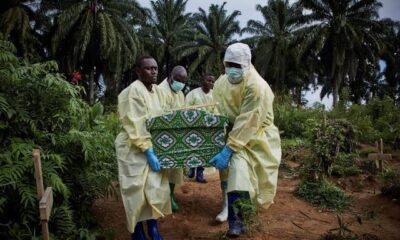
Médecins Sans Frontières (MSF) has raised concerns over the management of funds allocated to tackle the Ebola outbreak in the Democratic Republic of Congo (DR Congo), warning that hundreds of millions of dollars are not reaching frontline responders despite the worsening health crisis.The medical charity said health workers battling the outbreak were going unpaid, lacked adequate training and essential medical supplies, while some ambulances had run out of fuel.In a report, MSF described the outbreak as still being “out of control”, despite substantial funding committed to contain the disease.
More than 5,400 people have died and about 11,000 others infected since the outbreak was declared in May, making it the second-deadliest Ebola outbreak ever recorded.The organisation urged the Congolese government and United Nations agencies to strengthen financial oversight and accountability to ensure that funds already released are properly utilised.It said the response must prioritise adequately training, paying and equipping frontline personnel, while directing resources to communities with the greatest needs.“Despite the vast amounts of money provided for the response, many frontline responders are left trying to contain the outbreak with empty hands and empty pockets,” the report said.
The warning follows concerns raised last month by the Africa Centres for Disease Control and Prevention (Africa CDC), which said $700 million out of $962 million disbursed to organisations implementing the Ebola response remained unaccounted for.Africa CDC Director-General, Jean Kaseya, cautioned against immediately describing the discrepancy as embezzlement, attributing it instead to serious shortcomings in transparency and financial reporting.DR Congo’s Health Minister, Samuel-Roger Kamba, also criticised the lack of accountability among organisations involved in the response, saying only 22 per cent had submitted details of their activities to the ministry.“Our requirement is clear: transparency must be total.
The response relies on a single plan, a single budget, and a single coordination,” Mr Kamba said in a post on X.Frontline response hampered by shortagesMSF said the funding concerns were contributing to serious gaps in the response, including inadequate disease surveillance, poor contact tracing and shortages of essential supplies in health facilities.It reported that some surveillance teams existed only on paper, with little evidence of their activities on the ground.The organisation’s president, Javid Abdelmoneim, said its teams had repeatedly encountered serious operational failures.“Six months into the response, this situation is simply unacceptable,” he said.Contact tracing, which involves identifying and monitoring people who have come into contact with infected individuals, remains a critical measure for containing Ebola.
However, MSF said surveillance remained deeply problematic despite resources officially allocated to the activity. It added that about two-thirds of deaths were occurring in communities rather than treatment centres.British epidemiologist Neil Ferguson also warned that more than half of Ebola cases were going undetected, suggesting that the outbreak could continue for another year, according to Reuters.MSF further criticised the uneven distribution of resources, saying efforts were excessively concentrated in some areas while communities with more urgent needs received inadequate attention.It identified North Kivu province as an area where the response was too slow, while Haut-Uélé remained significantly neglected.Health facilities in the affected areas were reportedly struggling with shortages of basic necessities, including water, chlorine and proper triage systems.“This has turned some facilities into new centres of transmission, rather than places of care that contribute to containing the disease,” MSF said.Conflict complicates containment effortsThe outbreak is centred in eastern DR Congo, a region that has experienced decades of armed conflict, with some affected communities under the control of rebel groups.Poor road networks and insecurity have further complicated access to affected populations and the delivery of medical supplies.
The crisis has also coincided with severe food insecurity. The United Nations and the Congolese government recently warned that almost 10 million people in the wider affected region were in urgent need of food assistance.The outbreak, caused by the Bundibugyo species of the Ebola virus, has also spread beyond DR Congo, with cases reported in Kenya, Uganda and Nigeria.
However, Kenya recorded a major breakthrough on Wednesday when its last known Ebola patient was discharged from hospital, marking progress in efforts to contain the disease.The Bundibugyo species is relatively rare, and there is currently no approved vaccine or specific treatment for it, although clinical trials are ongoing.


Ebola outbreak: MSF raises alarm over missing funds, unpaid health workers in DR Congo

Why Is Türkiye Focusing on the Red Sea in Sudan?