
AFRICA FOCUS
Did Political Islam Engineer the “Mecca Agreement”? A Reading of an Alliance Where Interests Converge More Than Ideology

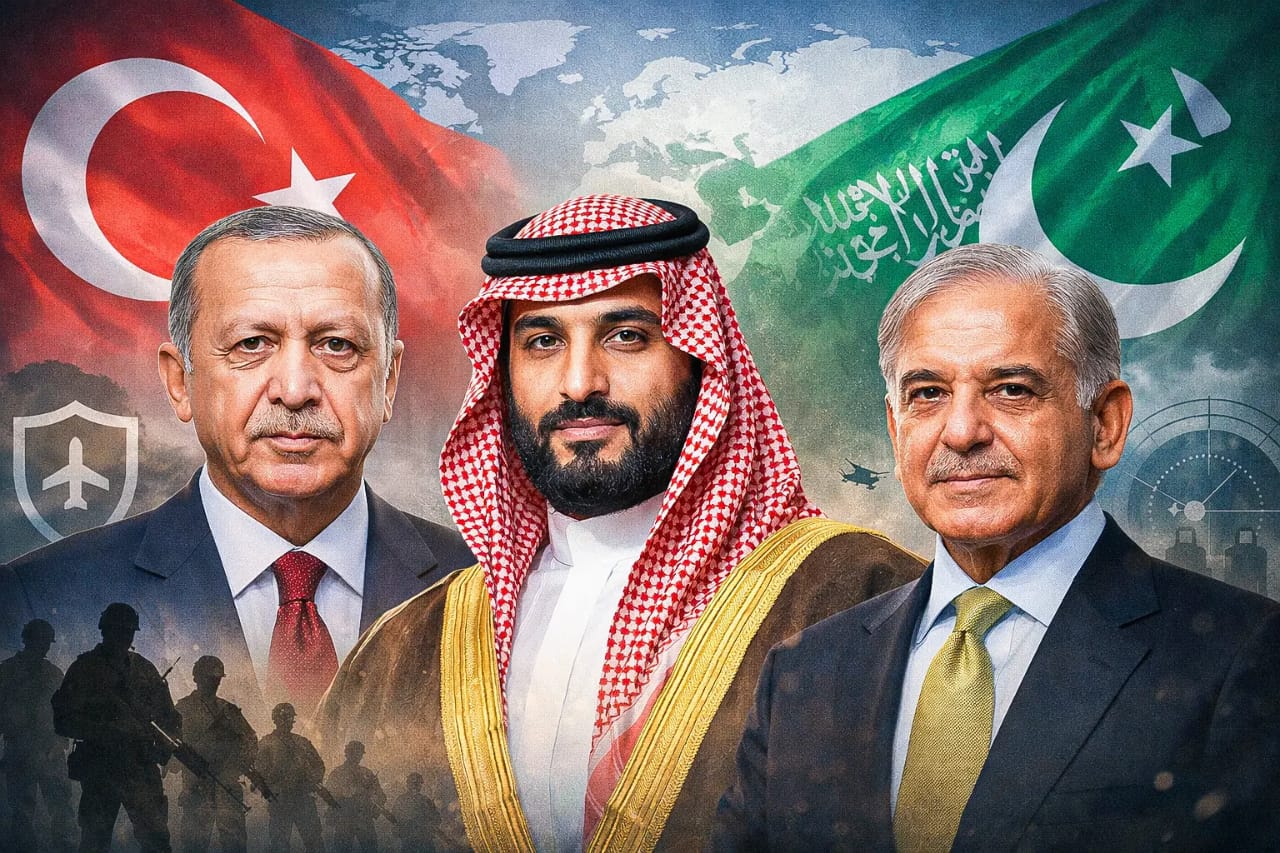
The “Mecca Agreement on Joint Defense” between Saudi Arabia, Turkey, and Pakistan raises a question that goes beyond its military substance: does the agreement merely reflect a convergence of security interests, or does it also signal the gradual return of political Islam to the sphere of regional influence after years of confrontation and isolation?
The agreement, announced on August 7, considers an attack on any one of the three countries an attack on all of them. Turkish Foreign Minister Hakan Fidan said that negotiations over the agreement had continued for about a year and that it came in response to the need to build regional arrangements better equipped to confront instability and external interference.
There is no evidence to support the claim that the Muslim Brotherhood or Islamist extremist groups played a role in shaping the agreement.
What was striking, however, was the Brotherhood’s strong celebration of it, regarding it as a step toward broader coordination among the countries of the Islamic world and calling for its expansion to include other states.
This welcome carries particular significance because Turkey, one of the parties to the agreement, has historically maintained strong ties with political Islamist currents, particularly under the current president, while Saudi Arabia stood on the opposite side over the past decade, designating the Muslim Brotherhood a terrorist organization and presenting its new policies as a break with political Islam.
Yet these boundaries have become less distinct. Despite its official position, Riyadh has maintained a practical relationship with Yemen’s Islah Party, the Muslim Brotherhood’s arm in Yemen, and it provides financial and military support to the Muslim Brotherhood and the Islamic Movement in Sudan.
The shift in Saudi-Turkish relations from political rivalry to a defense agreement also reveals that calculations of interest have come to take precedence over the ideological divisions that shaped the region over the past decade.
For this reason, the Brotherhood’s celebration of the agreement may be an attempt to interpret a broader transformation rather than evidence of its involvement in shaping it.
Journalist Hamid Karman believes that the group is seeking to capitalize on the agreement as an indication of the possibility of its return to the regional scene, while journalist Mohammed Sabti considers the shift in its rhetoric—from attacking Saudi Arabia to welcoming an alliance in which Riyadh is a participant—evidence of its ability to adapt its discourse to political shifts.
Yet the agreement’s real test will not lie in ideological positions, but in the conflicting interests of its parties.
Pakistan, for example, maintains deep strategic ties with Saudi Arabia but cannot treat Iran as an enemy. Iran is a neighboring state with which Pakistan shares files involving borders, Balochistan, energy, and security. Islamabad previously refused to participate militarily alongside Saudi Arabia in the war in Yemen, confirming that its alliance with Riyadh does not automatically mean entering its wars.
Here lies the central dilemma: What would happen if Saudi Arabia entered into a direct confrontation with Iran? Would Riyadh fight alongside Pakistan if a war erupted with India? And to what extent can Turkey, a NATO member, turn the Mecca Agreement into a military commitment in conflicts that do not directly affect its security?
These questions reveal that the three countries do not share a common definition of the enemy, nor a unified political or security doctrine.
Saudi Arabia is seeking a broader deterrence umbrella after its weakness and strategic vulnerability vis-à-vis the Houthis became apparent over a decade; Turkey is seeking to expand its regional influence; and Pakistan is seeking to benefit from its Saudi partnership without sacrificing its ties with Iran or China or becoming involved in conflicts far removed from its interests.
It therefore appears premature to describe the Mecca Agreement as a political Islam project. More precisely, it is an alliance of interests in which Islamists have found a political opportunity.
From here, the more important question is not whether the Muslim Brotherhood engineered the agreement, but whether Saudi Arabia itself is reconsidering the policy that made confronting political Islam one of the defining factors in its regional alliances, while taking into account Saudi Arabia’s long history of investing in, using, and mobilizing political Islam.





Ajadi Honours Akingbile-Oluana Community’s 5th Anniversary, Donates Funds on Behalf of APM Candidates

Atiku accuses Tinubu of deflecting blame for Nigeria’s economic hardship